

Do you have the right team to implement your strategy? What should that look like—and how do you get there from here?
When embarking on a new strategic endeavor, I evaluate the team based on four criteria:
- Desire and drive to achieve the mission and vision of the organization
- Innate ability to consistently operate within the organization’s value system (transparency, honesty, integrity, doing the right thing…your value system)
- Experience, skills, and abilities to fill a needed role
- Desire and ability to tap valuable resources, especially when they have skills but lack experience (adaptability and growth mindset)
Criteria 1 and 2 are non-negotiable. If your team members aren’t aligned with your mission, vision, and values, they’ll slow everything down and undermine forward progress. Criteria 3 is ideal, but if you’re short on time or have people with deep company knowledge, 4 can work too—as long as 1 and 2 are strong.
To make 1 and 2 actionable, your mission, vision, and values must be documented, communicated clearly, and demonstrated daily—by you.
Those who don’t align may self-select out. Others may need coaching—or a tough decision. Either way, time is of the essence. The longer misalignment drags on, the harder it becomes to build momentum.
When I reflect on the teams I’ve led through crises, M&A events, and startup launches, their shared commitment to mission, vision, and values was the single most important ingredient to our success.
Once 1 and 2 are clear, you can assess 3 and 4:
- Define the roles you need to implement your strategy.
- Identify the experience, skills, and abilities that best fit those roles.
- Build a future org chart around those roles—not people.
- Compare it to your current org chart and assess the gaps.
Involve your team in this process. Transparency and inclusion help people stay engaged—and may spark their own decisions about their future.
A Fintech Case Study
The founder/CEO of a fintech company faced declining margins, stagnant growth, and a flat valuation. Wisely, he brought in a new CEO to take the reins and shift the company toward growth.
The org charts below show how the leadership team evolved:
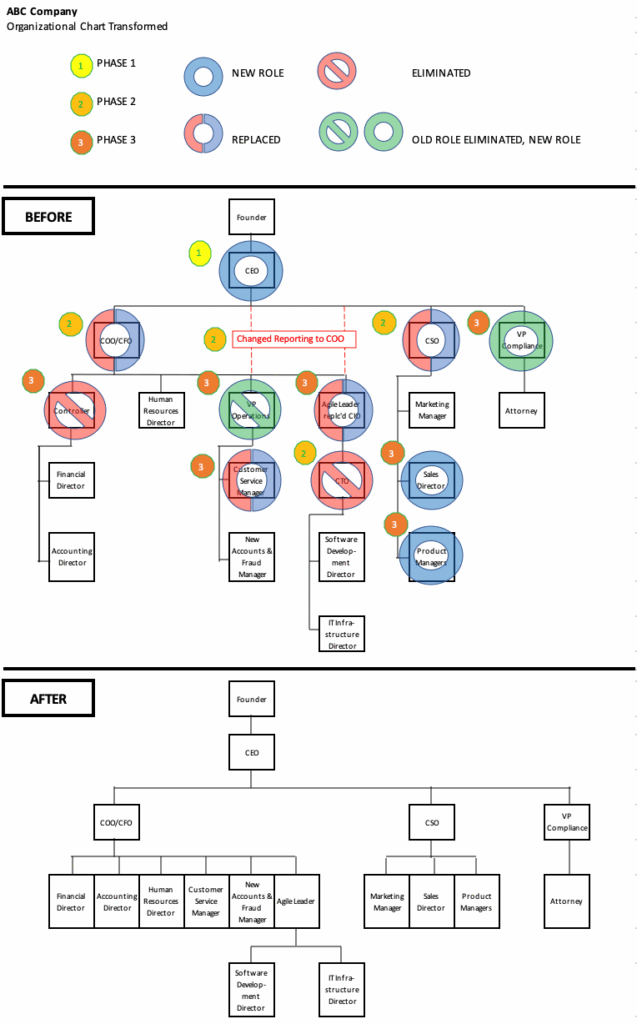
Across three phases, six people were replaced or eliminated, and one shifted roles. The result? A 300%+ increase in company valuation in under two years.
Many resources can guide you on hiring and “getting the right people in the right seats.” Fewer talk about how to transition people out—ethically and respectfully. Based on my experience, here are nine lessons learned:
- Engage HR and legal early. Compliance matters.
- Communicate your mission, vision, and direction before making personnel changes.
- Plan departures and transitions. Sometimes overlap works, sometimes it doesn’t.
- Treat exiting team members with professionalism and respect.
- Don’t expect everyone to understand or accept the change.
- Help soften their landing—severance, references, outplacement support.
- Co-create transition plans when possible.
- Communicate quickly and clearly with affected teams and the broader org.
- Be transparent with the remaining team. Talk through your reasoning and signal what’s next.
Every situation is different, and there will be more tactical considerations your HR and legal teams can help with. But at its core, leading a team through change is about clarity, consistency, and compassion.
The people you lead—those who leave and those you let go—will remember how you showed up.